![FMG_Logo_RGB_Small_Blk-1.png]](https://help.fmgsuite.com/hs-fs/hubfs/FMG_Logo_RGB_Small_Blk-1.png?width=75&height=49&name=FMG_Logo_RGB_Small_Blk-1.png)
Every page on your FMG website has its own SEO settings that control how it appears in search results like Google. This article explains what title tags and description tags are, what FMG fills in for you automatically, and how to write your own to help your pages stand out.
Jump to a section:
What are title tags and description tags?
Title tags and description tags are short pieces of text that tell search engines what your page is about. They live in your page's behind-the-scenes code (this is what's known as metadata), so you won't see them in the body of your page.
Search engines like Google use them to understand your page and decide how to show it in search results. The title usually appears as the clickable headline, and the description appears as the short summary underneath it.
Why are the Title and Description fields "blank"?
Every page on your website already has a title and description, even if these fields look empty. When they're left blank, FMG fills them in automatically for search engines:
- Title: uses the webpage headline (this is displayed either on the top of the page, or the tab name).
- Description: uses text pulled from your page's content.
This means your pages are never missing them. If you'd like more control over how your page appears in search results, you can write your own. Anything you enter here replaces the automatic generated version.
How Title Tags and Description Tags Appear on Search Engine Results
This is an example of how title tags and description tags will appear on search results:
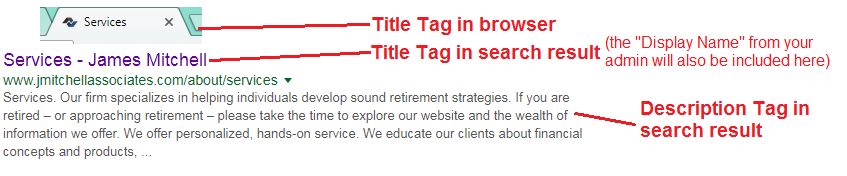
The above search results point to this page: https://www.jmitchellassociates.com/about/services
Using Page-Specific SEO Fields
At the bottom of every webpage in your admin, you will find SEO settings specific to that page under Advanced Settings:
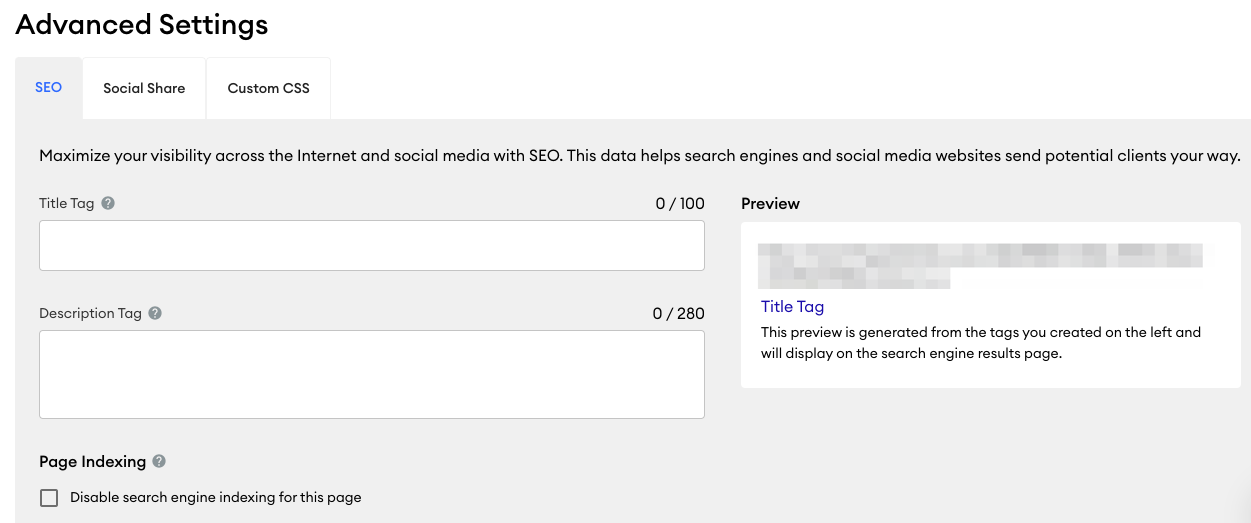
Here, you can add a custom Title Tag and Description Tag. When you create a page, these are filled in automatically, but you can replace them here with your own.
Title Tag
The Title Tag will automatically be populated with the "Page Headline" that you add when creating a page: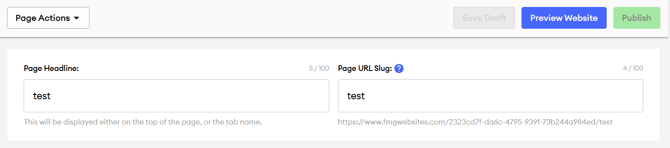
-
Where the title tag appears:
-
the page's name on your browser tab
-
on search engine results, where it will be the page's name
-
in the preview that appears when a link to your webpage is shared on social media
-
-
Aim for 50 to 60 characters, since longer titles are usually cut off in search results.
💡Search engines use the title tag as one of the signals in understanding what a page covers and how it ranks in search results, so try to include keywords about the page in your title tag.
Description Tag
-
Like the title tag, the meta Description Tag content is automatically generated. We will display the first few sentences on this page as your description tag. This content is only visible on search engine results.
-
Description tags do not directly affect your search ranking. What they affect is whether someone chooses your result over another one.
-
You may want to enter a custom description tag here to provide a summary of the content on the page, including any keywords or phrases that someone may search for, especially anything specific to your location. You can add up to 280 characters in your custom description.
-
For example, if a page was about financial planning, you could add a keyword phrase with "financial planning" in the description tag. You'll want to ensure your keyword phrase shows up at the beginning of the description tag as naturally as possible, such as "Let us help you with your financial planning process..."
-
-
Page Indexing
-
Under Page Indexing, you'll see a checkbox to Disable search engine indexing for this page. When this option is checked, it prevents search engines from crawling/indexing the page, and the page will not appear in search engine results.
-
You may want to do this if you're building a page that you only want specific clients to access: perhaps you're putting together a page full of helpful resources that you'd like to send to your clients.
-
💡Give Each Page Its Own Tags
Write a different title tag and description tag for every page you customize. Duplicate tags across multiple pages make it harder for search engines to tell your pages apart, which can work against the pages you most want people to find.
👀Looking for site-wide SEO tools like Google Analytics or your sitemap? See this help article: Website | SEO.