
Previously, disclosures could only be configured at the Account level, or at the Group level as a fallback if an Account didn't have its own — sent on every message, once a day, or once a month.
Rule-based disclosures replace this with a more flexible system: disclosures can now be triggered by different conditions, with more scheduling options for how often they're sent.
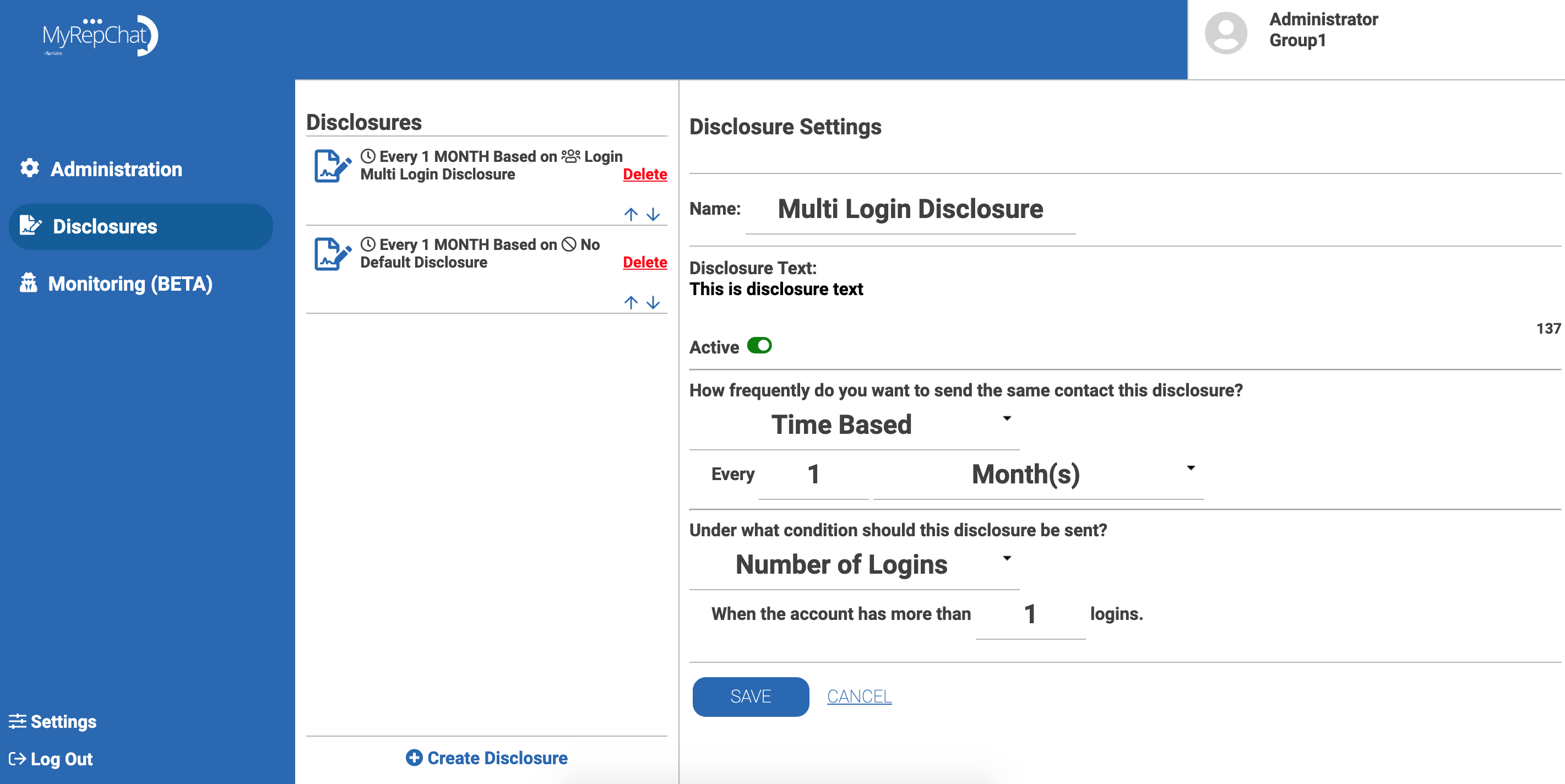
What Conditions Can Trigger a Disclosure?
- Specific Account: Choose a particular account this disclosure applies to — the same explicit, per-account behavior as before.
- Number of Logins: Send a disclosure to accounts with at least a specified number of logins — useful if an assistant may also be sending messages, not just the advisor.
- Location: Send a disclosure based on the account's state — useful when disclosure wording needs to vary by location.
- Unconditional: The default — no condition applies, and the disclosure always sends.
How Often Can a Disclosure Be Sent?
- Once: Sent only one time per contact.
- Always: Sent on every message.
- Time-Based: Sent after a specified amount of time has passed for each contact — configurable in days, months, or years.
Order matters. When an account sends a message, MyRepChat checks disclosures from the top of the list down, using the first one whose condition is met. If an account matches multiple conditions, only the top-most matching disclosure is used — lower matches are ignored.
What Happens to My Existing Disclosures?
If you already have disclosures configured, no action is needed. Your group-level disclosure automatically becomes an Unconditional disclosure and moves to the bottom of the list. Each account-level disclosure is automatically set to that account's specific condition.
You'll find and manage all disclosures from the Administration menu on the left. At the individual Account level, you can see which disclosure currently applies to that account, but it can no longer be configured there directly.